
One Love
A famous Jamaican expression representing unity, peace, love, and respect for others. Often used to express friendship, goodwill, or the belief that people should live together in harmony.
What Does One Love Mean?
“One Love” is one of Jamaica’s most famous expressions, representing unity, peace, respect, and love for humanity.
In Jamaican culture, “One Love” expresses the belief that people should live together in peace, show love to one another, and treat everyone with kindness and respect, regardless of their differences.
The expression is closely associated with reggae legend Bob Marley, whose music helped spread its message around the world.
But “One Love” is more than a famous song title.
It is an expression of goodwill, a message of togetherness, and an important part of Jamaica’s cultural identity.
You might hear someone say “One Love” when saying goodbye to a friend, showing appreciation, sending good wishes, or encouraging peace and understanding.
Although the words are simple, their meaning carries a powerful message: we are all connected, and we should treat one another with love and respect.
What Does One Love Mean in Jamaican Patois?
In Jamaican Patois, “One Love” generally means unity, peace, mutual respect, and goodwill toward others.
Unlike many Jamaican Patois expressions that require translation, “One Love” uses familiar English words.
However, its cultural meaning goes beyond the literal meaning of the two words.
When a Jamaican says “One Love,” they may be expressing friendship, appreciation, solidarity, or a sincere wish for someone’s well-being.
Depending on the situation, it can communicate messages such as:
- Love and respect.
- Peace and unity.
- We’re all connected.
- Take care of yourself.
- Blessings and good wishes.
- No hard feelings.
For example, someone might say:
🇯🇲 Jamaican: “One Love, mi bredda.”
📖 English Translation: “Love and respect, my brother.”
In this context, “One Love” expresses warmth, friendship, and mutual respect.
It doesn’t necessarily refer to romantic love.
Instead, it often represents a broader sense of love for other people, regardless of their background, beliefs, or circumstances.
How Is One Love Used in Jamaica?
“One Love” can be used in several situations, particularly when expressing goodwill, friendship, respect, or a desire for peace.
It is especially recognizable in reggae and Rastafari-influenced cultural settings.
Here are five examples of how the expression can be used.
1. To Say Goodbye
🇯🇲 Jamaican: “One Love, mi fren. Walk good.”
📖 English Translation: “Love and respect, my friend. Take care.”
Someone might say this when leaving a friend or ending a friendly conversation.
In this situation, “One Love” is a warm expression of goodwill.
It communicates positive feelings toward the other person while wishing them well.
2. To Show Appreciation
🇯🇲 Jamaican: “Respect fi di help. One Love.”
📖 English Translation: “Thanks for the help. Much love and respect.”
This can be used to express gratitude to someone who has offered assistance.
Rather than simply saying thank you, the speaker adds a sense of warmth and appreciation.
3. To Express Friendship
🇯🇲 Jamaican: “One Love, mi bredda.”
📖 English Translation: “Love and respect, my brother.”
This expresses friendship, solidarity, and mutual respect.
The word “bredda” is a Jamaican form of “brother,” often used when referring to a male friend.
In this example, “One Love” reinforces the bond between the speakers.
4. To Encourage Peace
🇯🇲 Jamaican: “Wi fi live inna peace. One Love.”
📖 English Translation: “We should live in peace. One Love.”
This emphasizes the importance of unity, understanding, and peaceful relationships.
Here, the expression communicates a broader message about how people should treat one another.
5. To Send Good Wishes
🇯🇲 Jamaican: “One Love an’ blessings to everybody.”
📖 English Translation: “Love and blessings to everyone.”
This expresses goodwill and positive wishes toward a group of people.
It is the kind of message you might encounter in reggae-inspired social media posts, cultural celebrations, or friendly exchanges.
These examples illustrate possible uses rather than fixed phrases that every Jamaican uses regularly.
Is One Love a Jamaican Greeting?
“One Love” can be used as a friendly greeting or farewell, but it is primarily an expression of love, respect, and goodwill.
It is not a conventional everyday greeting in the same way as “Wah Gwaan,” which means “What’s going on?” or “How are you?”
Instead, “One Love” is often used to communicate positive feelings toward another person.
For example:
🇯🇲 Person 1: “Mi ago link yuh later.”
📖 English: “I’ll catch up with you later.”
🇯🇲 Person 2: “Alright, One Love.”
📖 English: “Alright, take care. Love and respect.”
In this conversation, “One Love” works as a warm and friendly farewell.
However, not every Jamaican uses the expression regularly. Its use varies according to the speaker, community, and social setting.
One Love and Bob Marley
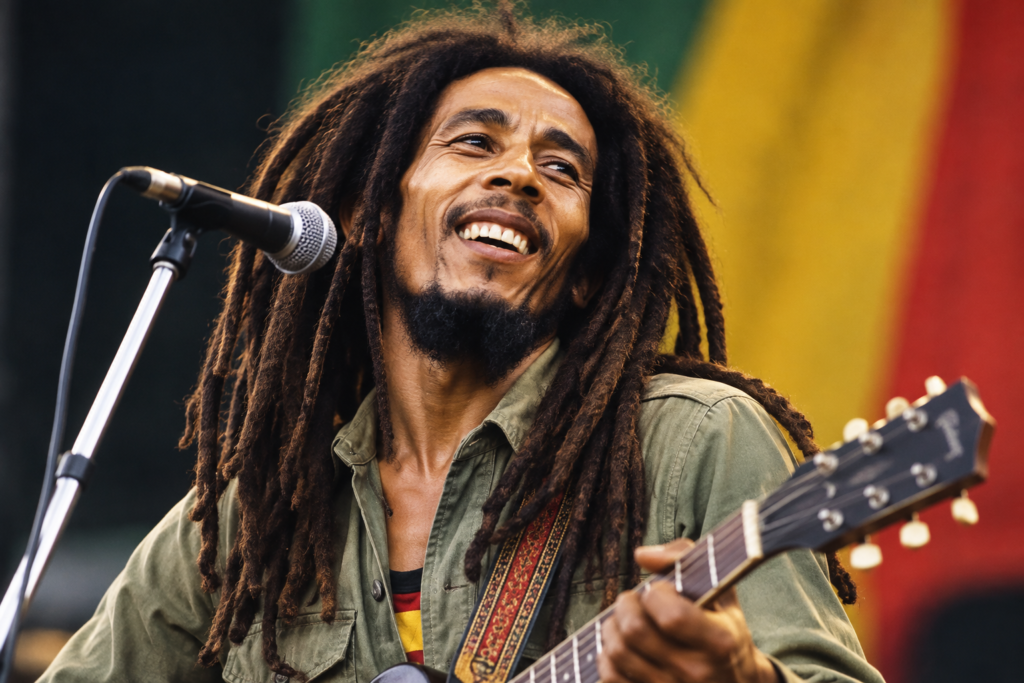
Bob Marley played a major role in making “One Love” one of the world’s most recognizable Jamaican expressions.
His famous song One Love, originally recorded by the Wailers in the 1960s and later released in a new version as One Love/People Get Ready, helped introduce the message of unity and peace to audiences around the world.
The song encourages people to come together and emphasizes the importance of love, harmony, and understanding.
Its message reflects themes that appear throughout Marley’s music, including social justice, spiritual awareness, freedom, and human dignity.
Although Marley did not invent the expression “One Love,” his music became deeply associated with it.
Over time, the phrase developed into an internationally recognized symbol of Jamaican culture.
Today, people around the world associate “One Love” with Bob Marley, reggae music, and Jamaica’s message of unity.
What Does Bob Marley’s One Love Mean?
The central message of Bob Marley’s One Love is that people should come together in peace and unity.
Rather than allowing hatred, division, and conflict to separate humanity, the song encourages togetherness.
The message is also connected to spiritual and religious themes.
Marley’s music was strongly influenced by Rastafari, a Jamaican religious and cultural movement that emphasizes African identity, spirituality, liberation, and justice.
In this context, “One Love” represents more than simply being friendly.
It expresses a vision of humanity living with greater understanding, dignity, and mutual respect.
Bob Marley: One Love (2024 Film)
The meaning of “One Love” gained renewed attention with the release of Bob Marley: One Love, a biographical film released in February 2024.
The movie tells the story of Jamaican reggae legend Bob Marley, focusing on an important period in his life when Jamaica was experiencing political tension and violence.
Starring Kingsley Ben-Adir as Bob Marley and Lashana Lynch as his wife, Rita Marley, the film explores Marley’s personal struggles, his music, and his commitment to spreading a message of peace and unity.
A central part of the story is Marley’s determination to bring people together through music, even during times of division and conflict.
The film highlights his involvement in the historic 1978 One Love Peace Concert in Kingston, Jamaica, where Marley famously brought rival political leaders Michael Manley and Edward Seaga together onstage.
Why Is the Movie Called One Love?
The film takes its title from Bob Marley’s famous song One Love, which became an international symbol of peace, unity, and togetherness.
The title reflects the message Marley promoted throughout his career: that people should overcome their differences and live with greater love and understanding.
Although the film explores difficult moments in Marley’s life, its title emphasizes the positive message that became central to his musical legacy.
For viewers unfamiliar with Jamaican culture, the movie also provides an introduction to the historical and social circumstances that shaped Marley’s music.
Today, One Love remains closely associated with Bob Marley, both through his famous song and the 2024 film celebrating his life.
One Love and Rastafarian Culture
“One Love” has a strong association with Rastafari, the religious and cultural movement that emerged in Jamaica during the 1930s.
Rastafari emphasizes spiritual consciousness, African heritage, liberation, and a sense of connection between people.
Ideas of unity, love, and respect are important within many Rastafari teachings.
The expression “One Love” fits naturally with these values.
It communicates the belief that people should recognize their shared humanity rather than focus only on their differences.
Reggae artists influenced by Rastafari helped spread this message internationally.
However, “One Love” is not exclusively a Rastafarian expression.
It is widely recognized outside Rastafari communities and is used by people with different religious beliefs and cultural backgrounds.
For many people, it simply expresses love, peace, friendship, and goodwill.
The Origin of One Love
The words “one” and “love” are ordinary English words, and the expression itself cannot be attributed to a single Jamaican inventor.
Its worldwide association with Jamaica developed largely through reggae music, Rastafari-influenced culture, and the international popularity of Bob Marley.
The Wailers recorded an early version of One Love in the 1960s.
The song was later reworked as One Love/People Get Ready for Bob Marley and the Wailers’ 1977 album Exodus.
The later version incorporated elements of Curtis Mayfield’s song People Get Ready, which contributed to its spiritual and unifying message.
As reggae music reached audiences beyond Jamaica, “One Love” became increasingly recognizable.
The expression eventually grew beyond its musical association to represent a broader message of peace and togetherness.
Today, it remains one of the most internationally recognized expressions associated with Jamaica.
Why Is One Love Associated With Jamaica?
“One Love” is strongly associated with Jamaica because of the country’s influence on global music and popular culture.
Reggae music, particularly the work of Bob Marley, introduced international audiences to Jamaican expressions and cultural ideas.
Through reggae, “One Love” became a recognizable message of unity and goodwill.
The phrase is now widely used in contexts connected to Jamaica, including cultural events, tourism, music, and public celebrations.
It also reflects values that many people associate with Jamaican culture, such as community, resilience, friendship, and respect.
However, Jamaican culture is diverse, and “One Love” should not be interpreted as a complete description of Jamaican society or the experiences of every Jamaican.
Its importance lies in the positive message it communicates and the role it has played in representing Jamaica internationally.
One Love vs. Irie: What’s the Difference?
Although “One Love” and “Irie” are both associated with positivity and Jamaican culture, they have different meanings.
| Expression | Meaning | Common use |
|---|---|---|
| One Love | Unity, peace, love, and respect | Expressing goodwill or togetherness |
| Irie | Feeling good, peaceful, content, or that everything is okay | Describing a feeling, mood, or situation |
For example:
🇯🇲 Jamaican: “Mi irie.”
📖 English Translation: “I’m feeling good.”
🇯🇲 Jamaican: “One Love, mi fren.”
📖 English Translation: “Love and respect, my friend.”
The difference is simple:
Irie describes a positive feeling or state of being, while One Love expresses love, unity, and goodwill toward others.
Both expressions are closely associated with Jamaican music and culture, but they are not interchangeable.
Learn more about the meaning of Irie here.
One Love on Social Media
“One Love” is widely used on social media to express positivity, appreciation, friendship, and togetherness.
It frequently appears in posts connected to Jamaican culture, reggae music, travel, and inspirational messages.
For example, someone sharing a photograph from Jamaica might write:
🇯🇲 “One Love from Jamaica.”
A person expressing appreciation for friends might post:
❤️ “Nothing but love and respect. One Love.”
Someone celebrating Bob Marley’s music might write:
🎶 “One Love. One Heart. One Jamaica.”
The expression is also commonly used in hashtags such as #OneLove, particularly in posts about music, friendship, peace, and unity.
Although the hashtag is used worldwide, its association with Jamaica remains especially strong.
Is One Love Still Used in Jamaica Today?
Yes. “One Love” remains a recognizable expression in Jamaica, particularly in cultural, musical, and Rastafari-influenced settings.
It can be used to express goodwill, respect, and solidarity.
However, its international fame does not mean that Jamaicans use it in every conversation.
Everyday Jamaican speech includes many other expressions, such as “Wah Gwaan,” “Respect,” “Big Up,” and “Walk Good.”
“One Love” is especially significant because of its cultural symbolism and its association with reggae music.
For Jamaicans and people around the world, it continues to communicate a message of unity, peace, and love.
One Love: Frequently Asked Questions
Here are answers to common questions about the meaning of “One Love” and its connection to Jamaica.
1. What does One Love mean in Jamaican Patois?
One Love means unity, peace, love, respect, and goodwill toward others. It expresses the idea that people should treat one another with kindness and understanding.
2. What does One Love mean in English?
The expression generally means love and respect for everyone, togetherness, or goodwill. Its meaning is cultural rather than a word-for-word translation from Jamaican Patois.
3. Why do Jamaicans say One Love?
Jamaicans may say “One Love” to express friendship, appreciation, peace, or respect. It is also strongly associated with reggae music and Rastafari-influenced culture.
4. Is One Love a Jamaican saying?
Yes. “One Love” is a well-known expression associated with Jamaica, although the words themselves are English and the broader idea of universal love is not unique to Jamaica.
5. Did Bob Marley invent One Love?
No. Bob Marley did not invent the expression. However, his famous song helped popularize it internationally and establish its strong association with Jamaican culture.
6. What does One Love mean in Bob Marley’s song?
The song promotes unity, peace, and togetherness. It encourages people to overcome divisions and recognize their shared humanity.
7. Is One Love a Rastafarian saying?
“One Love” is closely associated with Rastafari values, particularly unity and spiritual connection. However, it is not exclusively used by Rastafarians.
8. Is One Love a greeting or goodbye?
It can be used as either a friendly greeting or farewell, although it is primarily an expression of goodwill, friendship, and respect.
9. Does One Love mean romantic love?
Not usually. In Jamaican cultural contexts, “One Love” generally refers to universal love, unity, friendship, and respect rather than romantic affection.
10. How do you respond when someone says One Love?
You can simply reply “One Love” or “Respect.” Both can acknowledge the positive sentiment.
11. Is One Love Jamaican Patois?
“One Love” is an expression strongly associated with Jamaican culture, but the words themselves are standard English. Its significance comes primarily from its cultural meaning and use.
12. How do you pronounce One Love?
“One Love” is pronounced much as it is in English. Jamaican speakers may pronounce the words with features of their own accent or speech variety.
13. What is the difference between One Love and Irie?
“One Love” expresses unity, love, and respect toward others, while “Irie” describes feeling good, peaceful, content, or that everything is going well.
14. Is One Love still popular in Jamaica?
Yes. It remains culturally recognizable, especially through reggae music, Rastafari-influenced culture, and expressions of goodwill.
15. What does One Love symbolize?
“One Love” symbolizes peace, unity, respect, human connection, and the belief that people should live together with greater understanding.
How Much Do You Know About One Love?
Answer these five questions to test what you know.