Bredda
A Jamaican Patois word meaning brother, bro, or male friend. Used to refer to a biological brother or to address a friend or acquaintance with familiarity, friendship, or respect.
If you’ve ever listened to Jamaicans talking with their friends, watched a Jamaican movie, or enjoyed reggae and dancehall music, you’ve probably heard someone say “Bredda!”
It’s one of those Jamaican expressions that immediately communicates familiarity, friendship, and connection.
But what exactly does bredda mean in Jamaican Patois?
In this guide, you’ll learn the meaning of bredda in Jamaican Patois, how Jamaicans use it in everyday conversations, its connection to Jamaican culture, and the differences between bredda, bredren, and other Jamaican expressions.
What Does Bredda Mean in Jamaican Patois?
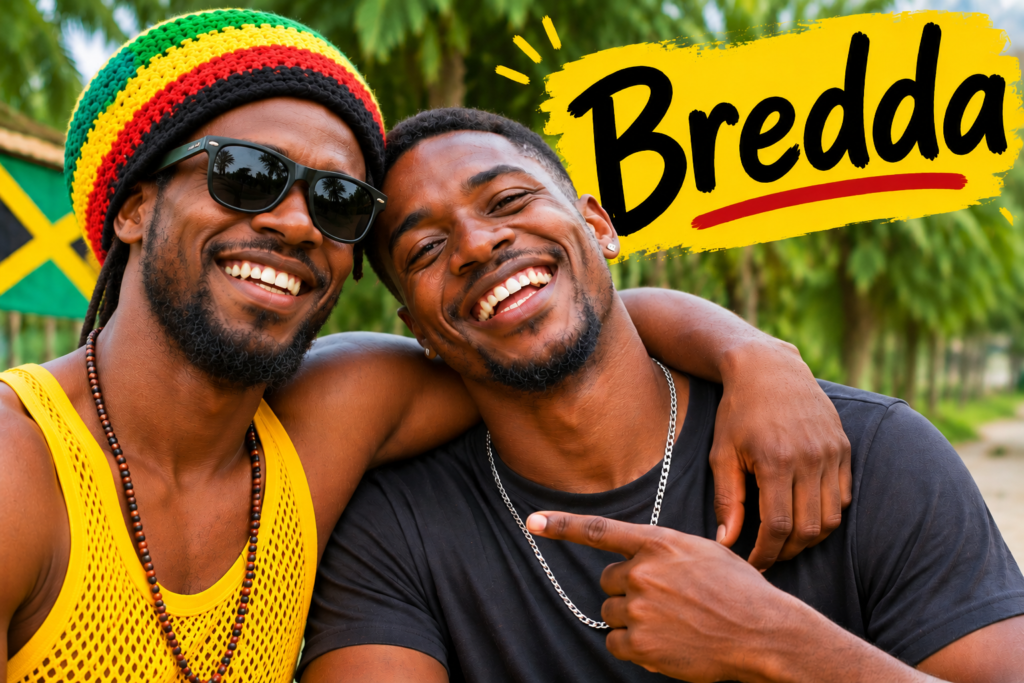
Bredda is the Jamaican Patois word for “brother.” It’s also commonly used to mean a male friend, companion, or someone addressed with familiarity or respect.
Although the word can refer to an actual brother, Jamaicans frequently use it when speaking to men who aren’t family members.
For example:
Jamaican Patois: “Wah gwaan, bredda?”
English translation: “What’s up, brother?”
In this sentence, the speaker is greeting someone in a friendly, familiar way.
Another example:
Jamaican Patois: “A mi bredda dat.”
English translation: “That’s my brother.” or “That’s my close friend.”
Depending on the context, the speaker might be referring to a biological brother or a trusted friend.
You might also hear:
Jamaican Patois: “Respect, mi bredda.”
English translation: “Respect, my brother.”
Here, bredda helps make the expression sound personal and appreciative.
The important thing to understand is that bredda doesn’t always indicate a family relationship.
In Jamaican speech, it can express a social connection as well as a biological one.
What Does Bredda Mean in English?
The closest English translation of bredda is “brother.”
However, depending on the conversation, it may also translate naturally as “bro,” “buddy,” “mate,” or “friend.”
| Jamaican meaning | English equivalent | How it’s used |
|---|---|---|
| Biological brother | Brother | Referring to a male sibling |
| Close male friend | Bro or brother | Expressing friendship |
| Familiar acquaintance | Buddy or mate | Addressing someone casually |
| Fellow man | Brother | Showing solidarity or respect |
| Friendly form of address | My man or bro | Greeting or speaking to someone |
For example:
Jamaican Patois: “Mi bredda live a Kingston.”
English translation: “My brother lives in Kingston.”
This could refer to a family member.
But consider:
Jamaican Patois: “Mi know dat bredda fi years.”
English translation: “I’ve known that guy for years.”
In the second example, bredda may simply refer to a man the speaker knows.
This flexibility makes the expression useful in many everyday conversations.
How Do You Pronounce Bredda?
Bredda is commonly pronounced “BREH-dah.”
The word has two syllables, with the emphasis generally on the first.
Bredda = BREH-dah
The first syllable sounds like breh, while the second sounds like dah.
The word comes from brother, but the pronunciation reflects Jamaican speech patterns.
For example:
“Wah gwaan, bredda?”
“What’s up, brother?”
When spoken naturally, the word may sound slightly different depending on the speaker’s accent and how quickly they’re talking.
You may also see the word written as bredah or bredder in informal attempts to represent its pronunciation, although bredda is a familiar spelling.
How Do Jamaicans Use Bredda in Everyday Conversations?
Bredda is a versatile expression that appears in greetings, friendly conversations, family discussions, and sometimes disagreements.
Here are some common situations where Jamaicans might use it.
1. To Greet a Friend
One of the most familiar uses of bredda is greeting another man.
Jamaican Patois: “Wah gwaan, mi bredda?”
English translation: “What’s up, my brother?”
Imagine two friends meeting on the street.
One might say:
“Wah gwaan, bredda?”
The other might respond:
“Everyting good, mi bredda.”
“Everything’s good, my brother.”
The exchange communicates friendliness and familiarity.
It’s similar to two friends greeting each other with “What’s up, bro?” in English.
2. To Refer to a Biological Brother
Bredda can also have its literal meaning.
Jamaican Patois: “Mi bredda older dan mi.”
English translation: “My brother is older than me.”
In this example, the speaker is talking about a male sibling.
Another example:
Jamaican Patois: “Mi have two bredda.”
English translation: “I have two brothers.”
Context usually makes it clear whether someone is referring to a family member or a friend.
3. To Show Respect
Jamaicans may use bredda when acknowledging someone or expressing appreciation.
Jamaican Patois: “Respect, mi bredda.”
English translation: “Respect, my brother.”
Imagine someone helping a friend carry something heavy.
The person receiving help might respond:
“Respect, bredda.”
It’s a warm, familiar way of expressing thanks or appreciation.
The word itself doesn’t automatically make a statement respectful, but it can reinforce a friendly tone.
4. To Refer to a Close Friend
Someone might describe a trusted friend as mi bredda, even when there’s no biological relationship.
Jamaican Patois: “Him a mi bredda from long time.”
English translation: “He’s been like a brother to me for a long time.”
This suggests a strong friendship or longstanding connection.
For example, two people who grew up together might refer to each other as brothers.
In this context, bredda communicates closeness rather than family ties.
5. To Get Someone’s Attention
Bredda can also be used when addressing a man directly.
Jamaican Patois: “Bredda, listen weh mi a seh.”
English translation: “Brother, listen to what I’m saying.”
The speaker may be trying to explain something or get someone’s attention.
Depending on the tone, the statement could sound friendly, serious, impatient, or firm.
This is an important reminder that bredda isn’t always used in an affectionate situation.
6. To Express Concern
Sometimes Jamaicans use bredda when checking on someone’s well-being.
Jamaican Patois: “Yuh alright, mi bredda?”
English translation: “Are you alright, my brother?”
Imagine a friend looking upset or unusually quiet.
Someone might ask:
“Wah happen, bredda?”
“What happened, brother?”
Here, the word adds familiarity to a question expressing concern.
7. To Disagree or Challenge Someone
Although bredda is often friendly, it can also appear in a disagreement.
Jamaican Patois: “Bredda, weh yuh a seh?”
English translation: “Brother, what are you saying?”
Depending on the speaker’s tone, this could be a genuine request for clarification or a challenge to what someone has said.
Similarly:
“Bredda, nuh do dat.”
“Brother, don’t do that.”
The expression can sound like advice, a warning, or a firm instruction.
The word itself isn’t offensive, but the overall message may be serious.
Bredda Examples in Jamaican Patois
Here are some examples of bredda in everyday Jamaican conversations.
| Jamaican Patois | English translation |
|---|---|
| “Wah gwaan, bredda?” | “What’s up, brother?” |
| “Respect, mi bredda.” | “Respect, my brother.” |
| “A mi bredda dat.” | “That’s my brother.” |
| “Mi bredda deh a yard.” | “My brother is at home.” |
| “Yuh alright, bredda?” | “Are you alright, bro?” |
| “Bredda, come yah.” | “Brother, come here.” |
| “Mi know dat bredda.” | “I know that guy.” |
| “Dat bredda cool.” | “That guy is cool.” |
| “Mi bredda help mi.” | “My brother helped me.” |
| “Big up yuhself, bredda.” | “Much respect to you, brother.” |
| “Bredda, weh yuh a do?” | “Brother, what are you doing?” |
| “Mi have one bredda.” | “I have one brother.” |
| “Bredda, tek yuh time.” | “Brother, take your time.” |
| “A weh dat bredda deh?” | “Where’s that guy?” |
| “Mi bredda just reach.” | “My brother just arrived.” |
| “Bredda, mi nuh agree.” | “Brother, I don’t agree.” |
| “Dat bredda always mek mi laugh.” | “That guy always makes me laugh.” |
| “Give thanks, mi bredda.” | “Thanks, my brother.” |
| “Mi bredda live overseas.” | “My brother lives overseas.” |
| “See yuh later, bredda.” | “See you later, bro.” |
These examples show that bredda can refer to a relative, a friend, or simply a man being addressed.
The surrounding words and relationship between speakers help determine the intended meaning.
As with many Jamaican Patois expressions, spelling and sentence structure can vary.
What Does “Mi Bredda” Mean?
“Mi bredda” means “my brother” or “my bro.”
It’s one of the most common ways to use the word.
In Jamaican Patois, mi can mean “my” when used possessively.
Therefore:
- Mi = My
- Bredda = Brother
- Mi bredda = My brother
For example:
Jamaican Patois: “Mi bredda a come tomorrow.”
English translation: “My brother is coming tomorrow.”
This could refer to a biological brother.
But someone might also say:
Jamaican Patois: “Yuh a mi bredda.”
English translation: “You’re my brother.”
In the second example, the speaker could be expressing a close friendship.
The phrase may communicate loyalty, trust, or affection, depending on the relationship.
What Does “Wah Gwaan, Bredda?” Mean?
“Wah gwaan, bredda?” means “What’s going on, brother?” or “What’s up, bro?”
It’s a friendly greeting.
The phrase combines two common Jamaican expressions:
Wah gwaan means “What’s going on?” or “What’s happening?”
Bredda means “brother” or “bro.”
Together, they create a natural greeting between people who know each other or are speaking casually.
For example:
Person A: “Wah gwaan, bredda?”
Person B: “Mi deh yah, man. Everyting good.”
English translation:
Person A: “What’s up, bro?”
Person B: “I’m here, man. Everything’s good.”
The greeting doesn’t necessarily mean the speaker is asking for a detailed explanation of what’s happening.
Like “What’s up?” in English, it can simply be a way of saying hello.
What Does “Respect, Bredda” Mean?
“Respect, bredda” is a familiar expression of appreciation, acknowledgment, or goodwill.
Depending on the context, it may mean:
- “Thanks, brother.”
- “Much respect, bro.”
- “I appreciate you, brother.”
- “Respect to you, my friend.”
For example:
Jamaican Patois: “Respect, bredda. Mi appreciate di help.”
English translation: “Thanks, brother. I appreciate the help.”
You might hear the phrase when someone does a favor, offers encouragement, or shows kindness.
It’s also possible to use it as a friendly acknowledgment rather than a direct thank-you.
The word respect is particularly common in Jamaican greetings and informal exchanges.
Adding bredda makes the expression more personal.
What Does “Big Up Mi Bredda” Mean?
“Big up mi bredda” means to praise, acknowledge, or show appreciation for one’s brother or friend.
In Jamaican speech, big up is commonly used to express praise, recognition, or respect.
For example:
Jamaican Patois: “Big up mi bredda fi di support.”
English translation: “Much respect to my brother for the support.”
The speaker is acknowledging someone who has helped or supported them.
Another example:
Jamaican Patois: “Big up mi bredda dem.”
English translation: “Big up my brothers.”
This may refer to friends, relatives, or a wider group of people the speaker feels connected to.
The expression can be heard in everyday conversation, social media messages, and Jamaican music.
What Does “Dat Bredda” Mean?
“Dat bredda” means “that brother,” “that man,” or “that guy,” depending on the context.
For example:
Jamaican Patois: “Dat bredda funny.”
English translation: “That guy is funny.”
Here, the speaker is referring to a man.
Another example:
Jamaican Patois: “Mi know dat bredda.”
English translation: “I know that guy.”
This doesn’t necessarily mean the person is a close friend or relative.
It could simply refer to someone the speaker recognizes.
In this sense, bredda can function similarly to “guy” or “fellow” in conversational English.
Is Bredda the Same as Brother?
Yes, bredda is the Jamaican Patois equivalent of brother, but the two aren’t always used in exactly the same way.
In standard English, brother primarily refers to a male sibling, although it can also express friendship, solidarity, or religious fellowship.
In Jamaican Patois, bredda likewise has both literal and social meanings.
| Brother | Bredda |
|---|---|
| Standard English spelling | Jamaican Patois spelling |
| Refers to a male sibling | Can refer to a male sibling |
| Can express friendship or solidarity | Frequently used as a familiar form of address |
| Used in formal and informal English | Most natural in Jamaican speech and informal contexts |
| “That’s my brother.” | “A mi bredda dat.” |
For example, someone saying “Mi bredda” might be referring to a sibling.
But when someone greets an acquaintance with “Wah gwaan, bredda?”, the word may simply mean “bro.”
The context determines whether the meaning is literal or figurative.
Bredda vs. Bredren: What’s the Difference?
One of the most common questions about bredda concerns its relationship to bredren.
The two expressions are related, but they have differences in usage.
Bredda is a Jamaican form of “brother” and can refer to an individual male sibling, friend, or acquaintance.
Bredren is associated with the English word brethren and is often used to refer to brothers, companions, or members of a group. In Jamaican and Rastafari-influenced speech, it can also refer to a male friend or fellow member of a community.
| Bredda | Bredren |
|---|---|
| Jamaican form of “brother” | Related to “brethren” |
| Often refers to one man | Can refer to a group or an individual |
| Common in casual greetings | Common in friendship and community contexts |
| Can mean a biological brother | Often emphasizes fellowship or connection |
| “Wah gwaan, bredda?” | “Wah gwaan, mi bredren?” |
For example:
Bredda: “A mi bredda dat.”
“That’s my brother.”
Bredren: “Mi bredren dem deh yah.”
“My friends are here.”
It’s important not to assume that bredren is always plural.
In Jamaican usage, it can also refer to one male friend.
Similarly, bredda isn’t restricted to biological relatives.
The distinction depends on how the words are used in context.
Bredda vs. Bro: Are They the Same?
Bredda and bro can have nearly identical meanings in casual conversation.
Both may refer to a male friend or be used as a familiar form of address.
For example:
Jamaican Patois: “Wah gwaan, bredda?”
English translation: “What’s up, bro?”
The main difference is cultural and linguistic.
Bro is widely used in informal English across many countries.
Bredda is particularly associated with Jamaican Patois and Jamaican-influenced speech.
Someone learning Jamaican Patois may find that translating bredda as bro often sounds more natural than translating it as the more formal-sounding brother.
However, brother remains the closest literal translation.
Bredda vs. Yute: What’s the Difference?
Both bredda and yute can be used when referring to a male person, but they don’t mean the same thing.
Bredda means “brother” and can also mean “bro” or “male friend.”
Yute is the Jamaican Patois form of “youth” and generally refers to a young person.
For example:
Bredda: “Dat bredda cool.”
“That guy is cool.”
Yute: “Dat yute talented.”
“That young person is talented.”
The difference is that bredda often emphasizes familiarity or brotherhood, while yute emphasizes youth.
A person described as bredda doesn’t have to be young.
An older man may be addressed as bredda just as naturally as a younger man, depending on the relationship and setting.
Bredda vs. Dawg: What’s the Difference?
In Jamaican informal speech, dawg can also be used as a friendly term for a male friend.
However, the two words have slightly different associations.
Bredda comes from “brother” and can suggest familiarity, respect, or a brotherly connection.
Dawg is a slang term that can suggest friendship, closeness, or camaraderie.
For example:
Bredda: “Respect, mi bredda.”
“Respect, my brother.”
Dawg: “Wah gwaan, dawg?”
“What’s up, bro?”
Both can be friendly, but dawg often has a more distinctly slang-oriented feel.
The best choice depends on the speaker’s usual vocabulary and relationship with the person being addressed.
Other Jamaican Patois Words Similar to Bredda
Jamaicans use several familiar expressions when referring to friends, relatives, and acquaintances.
| Jamaican expression | Meaning | Example |
|---|---|---|
| Bredda | Brother, bro, male friend | “Wah gwaan, bredda?” |
| Bredren | Brother, friend, or companions | “Mi bredren dem.” |
| Sistren | Sister or female companion | “Mi sistren dem.” |
| Dawg | Friend, buddy, bro | “Wah gwaan, dawg?” |
| Yute | Youth or young person | “Dat yute smart.” |
| Idren | Fellow person or companion, especially in Rastafari-influenced speech | “Respect, idren.” |
| Fam | Family or close friend | “Wah gwaan, fam?” |
| Parri | Friend or companion | “A mi parri dat.” |
These words overlap in some contexts, but they aren’t always interchangeable.
For example, yute primarily identifies someone as young, while bredda can be used for a man of almost any age.
Likewise, sistren is associated with female companionship or sisterhood, while bredda generally refers to men.
Learning the differences can help you better understand Jamaican conversations.
Where Did the Jamaican Word Bredda Come From?
The Jamaican Patois word bredda developed from the English word brother.
Jamaican Patois, also called Jamaican Creole, developed through historical contact between English and West African languages during Jamaica’s colonial period.
Over time, Jamaican Creole developed its own pronunciation patterns, grammar, and vocabulary.
Bredda reflects a Jamaican Creole pronunciation of the English word brother.
The word is an example of how English-derived vocabulary can take on distinctive forms in Jamaican Patois.
Importantly, Jamaican Patois isn’t simply English spoken with an accent.
It’s a language variety with its own grammatical structures and linguistic history.
Words such as bredda are part of that broader linguistic tradition.
The word’s extended use for friends and acquaintances also reflects a familiar feature of many languages: family terms can be used to express social closeness and solidarity.
Bredda in Jamaican Culture
In Jamaica, bredda can communicate more than a literal family relationship.
It may express familiarity, friendship, respect, or a shared sense of belonging.
For example, someone might refer to a lifelong friend as mi bredda because the friendship feels similar to a family bond.
A neighbor may greet another man with “Wah gwaan, bredda?” without implying that they are particularly close.
The expression can also appear in conversations about supporting or helping one another.
Jamaican Patois: “Help out yuh bredda.”
English: “Help out your brother.”
Depending on the situation, the speaker may be referring to an actual sibling or encouraging someone to support another person.
However, it would be inaccurate to assume that every use of bredda communicates deep friendship or a special cultural philosophy.
Sometimes it’s simply a casual way of addressing a man.
That flexibility is part of what makes the word so common and useful.
Bredda in Rastafari Language and Culture
Bredda is also used in Rastafari-influenced speech, where ideas of brotherhood, unity, and community can be especially meaningful.
Rastafari emerged in Jamaica during the twentieth century and developed distinctive cultural, spiritual, and linguistic practices.
Within Rastafari communities, terms associated with brotherhood and fellowship can communicate a shared identity or spiritual connection.
For example:
“Respect, mi bredda.”
Depending on the context, this might express appreciation or solidarity.
However, bredda isn’t exclusively a Rastafari word.
It’s part of broader Jamaican Patois and is used by Jamaicans with many different backgrounds and beliefs.
Another important distinction is that bredren and idren may carry particular associations in Rastafari speech.
Although these expressions are related through ideas of fellowship, they shouldn’t automatically be treated as identical.
Bredda in Reggae and Dancehall Music
Reggae and dancehall have helped introduce Jamaican expressions to listeners around the world.
Bredda is one of the words listeners may encounter in Jamaican music, performances, and conversations involving artists.
The word fits naturally into discussions about friendship, loyalty, community, and everyday experiences.
For example, an artist might refer to a friend as mi bredda.
A performer might also address an audience member or another musician as bredda.
In a song about friendship, the expression could emphasize a personal connection.
In a more serious song, it might be used while giving advice or addressing another person.
The meaning depends on the lyrics and context.
Reggae and dancehall have played important roles in spreading Jamaican vocabulary internationally, but bredda remains an everyday Jamaican expression rather than a term limited to music.
Is Bredda Jamaican Slang?
Yes. Bredda is often described as Jamaican slang, although it’s also a regular Jamaican Patois word for “brother.”
There’s an important distinction here.
When someone uses bredda to refer to a biological brother, they’re using a Jamaican Creole vocabulary word.
When someone uses it to address a friend or acquaintance, the expression can function like informal slang.
For example:
Literal meaning: “Mi bredda live a Spanish Town.”
“My brother lives in Spanish Town.”
Informal meaning: “Wah gwaan, bredda?”
“What’s up, bro?”
Both uses are natural in Jamaican speech.
Calling it slang is understandable, but learners should also recognize that it belongs to Jamaican Patois as a language.
Is Bredda a Compliment in Jamaica?
Bredda isn’t exactly a compliment in the same way as calling someone attractive, talented, or stylish.
Instead, it’s a familiar term of address.
However, it can communicate positive feelings.
For example:
“Respect, mi bredda.”
This sounds appreciative and friendly.
Similarly:
“Yuh a mi bredda.”
This can express affection or closeness.
But the word itself doesn’t guarantee that the speaker is praising someone.
Consider:
“Bredda, stop dat.”
“Brother, stop that.”
Here, the speaker is giving a firm instruction.
Therefore, bredda is generally neutral to positive, depending on how it’s used.
Can Bredda Be Used in an Argument?
Yes. Although bredda is commonly friendly, it can also be used during disagreements or tense conversations.
For example:
Jamaican Patois: “Bredda, weh yuh mean?”
English translation: “Brother, what do you mean?”
Depending on the tone, this could be a simple question or an expression of disbelief.
Another example:
Jamaican Patois: “Bredda, mi tell yuh already.”
English translation: “Brother, I already told you.”
The speaker may sound frustrated or impatient.
This is similar to how someone might use the English word bro during an argument.
For example, “Bro, what are you doing?” can sound friendly or annoyed depending on the situation.
The same principle applies to bredda.
Can Bredda Refer to Someone Who Isn’t Jamaican?
Yes. Bredda can refer to a man regardless of nationality.
For example, a Jamaican might greet a male friend from another country by saying:
“Wah gwaan, bredda?”
The word doesn’t require the person being addressed to be Jamaican.
It’s simply a Jamaican way of saying “brother” or “bro.”
The relationship between the speakers and the situation determine whether it sounds natural.
Can Women Use the Word Bredda?
Yes. Women can use bredda when referring to or addressing men.
The word isn’t restricted to male speakers.
For example, a Jamaican woman might say:
Jamaican Patois: “A mi bredda dat.”
English translation: “That’s my brother.”
She could be referring to her biological brother or a close male friend.
A woman might also greet a male friend with:
“Wah gwaan, bredda?”
Although bredda generally refers to men, people of different genders can use the expression.
What Is the Female Equivalent of Bredda?
The closest literal female equivalent of bredda is sista, the Jamaican Patois form of “sister.”
Another related expression is sistren, which can refer to sisters or female companions, particularly in contexts emphasizing fellowship or community.
For example:
Jamaican Patois: “A mi sista dat.”
English translation: “That’s my sister.”
And:
Jamaican Patois: “Respect, mi sistren.”
English translation: “Respect, my sister.”
However, sista and sistren aren’t always interchangeable in every context.
Just as bredda and bredren have overlapping but distinct uses, the appropriate female term depends on the speaker and situation.
Can Tourists and Non-Jamaicans Say Bredda?
Yes. Tourists and non-Jamaicans can use bredda when they understand its meaning and the context.
For example, if you’ve developed a friendly relationship with someone in Jamaica, you might say:
“Respect, bredda.”
This can be a natural way to express appreciation.
However, it’s best not to force Jamaican expressions into every conversation.
You don’t need to imitate a Jamaican accent or use unfamiliar phrases to show appreciation for Jamaican culture.
Understanding when and why Jamaicans use bredda is more valuable than simply repeating the word.
If you’re unsure, using familiar English expressions such as “brother,” “friend,” or “thanks” is perfectly fine.
Is Bredda a Bad Word?
No. Bredda isn’t a swear word or an inherently offensive expression.
It means “brother” and is commonly used in friendly or familiar conversations.
For example:
“Wah gwaan, bredda?”
This is an ordinary greeting.
However, tone matters.
Someone can use bredda in an argument, a warning, or a sarcastic remark.
That doesn’t make the word itself offensive.
It simply means that the overall meaning of a sentence depends on how it’s delivered.
Is Bredda Used Outside Jamaica?
Yes. Bredda is used and recognized beyond Jamaica, particularly in communities influenced by Jamaican language and culture.
Jamaican diaspora communities in countries such as the United Kingdom, the United States, and Canada may use the word.
Reggae, dancehall, and other forms of Jamaican popular culture have also introduced the expression to international audiences.
You may encounter bredda in Jamaican-influenced music, online conversations, or everyday speech outside Jamaica.
However, its strongest linguistic association remains Jamaican Patois.
Common Mistakes People Make With Bredda
Although bredda is relatively easy to understand, learners sometimes misunderstand how it’s used.
Mistake 1: Thinking Bredda Always Means a Biological Brother
This is probably the most important misconception.
Bredda can refer to a biological brother, but it can also mean a friend, acquaintance, or man being addressed.
For example:
“Wah gwaan, bredda?”
The speaker doesn’t have to be greeting a relative.
Mistake 2: Assuming Bredda Is Always Affectionate
The word is often friendly, but it can also appear in serious or tense conversations.
For example:
“Bredda, nuh do dat.”
“Brother, don’t do that.”
Depending on the speaker’s tone, this could be advice or a warning.
Mistake 3: Thinking Bredda and Bredren Are Always Interchangeable
Although the two words are related, their usage isn’t identical.
Bredda is the Jamaican form of “brother.”
Bredren is related to “brethren” and can emphasize companionship or group identity, although it may also refer to an individual.
Mistake 4: Thinking Only Men Can Say Bredda
Women can use bredda when speaking about or addressing men.
The word generally identifies the person being referred to, not the gender of the speaker.
Mistake 5: Assuming Bredda Is Exclusively Rastafarian
Bredda appears in Rastafari-influenced speech, but it’s also part of everyday Jamaican Patois.
People don’t have to belong to the Rastafari movement to use it.
Mistake 6: Using Bredda in Every Situation
Although bredda can sound friendly, it’s an informal expression.
It may not be appropriate in every professional or formal setting.
As with any expression, the relationship between speakers and the social context matter.
Bredda: Frequently Asked Questions
Here are some frequently asked questions about “bredda” to help you understand its meaning and how Jamaicans use it.
1. What does bredda mean in Jamaican slang?
Bredda means “brother,” “bro,” or “male friend.” It can refer to a biological brother or be used as a familiar way of addressing a man.
2. What is the English meaning of bredda?
The closest English translation is “brother.” In casual conversation, it can also mean “bro,” “buddy,” or “mate.”
3. How do you pronounce bredda?
Bredda is commonly pronounced “BREH-dah,” with two syllables and the emphasis on the first.
4. What does “mi bredda” mean?
“Mi bredda” means “my brother” or “my bro.”
5. What does “wah gwaan, bredda” mean?
It means “What’s going on, brother?” or “What’s up, bro?” It’s a friendly greeting.
6. Is bredda a Jamaican word?
Yes. Bredda is a Jamaican Patois form of the English word “brother.”
7. Does bredda mean a friend?
Yes. Bredda can refer to a friend, especially a male friend, even when the people aren’t related.
8. Is bredda a bad word?
No. Bredda isn’t a swear word or an inherently offensive expression.
9. Is bredda a compliment?
Not exactly. It’s a familiar term of address that can express friendship, respect, or solidarity.
10. What is the difference between bredda and bredren?
Bredda is a form of “brother.” Bredren is related to “brethren” and can refer to friends, companions, or members of a group. It can also be used for one person.
11. What does “respect, bredda” mean?
It’s a familiar expression of appreciation or acknowledgment, similar to “Much respect, brother” or “Thanks, bro.”
12. What does “big up mi bredda” mean?
It means to praise, acknowledge, or show appreciation for one’s brother or friend.
13. Can bredda refer to a biological brother?
Yes. The word can refer to an actual male sibling.
14. Can bredda refer to someone who isn’t family?
Yes. Jamaicans frequently use it when referring to or addressing friends and acquaintances.
15. Is bredda the same as bro?
In many casual conversations, yes. Both can be used as familiar ways of addressing a male friend.
16. Is bredda used in reggae music?
Yes. The word can appear in reggae and other Jamaican music, particularly in contexts involving friendship, community, and everyday conversation.
17. Is bredda used in dancehall?
Yes. Bredda is part of Jamaican everyday speech and can also appear in dancehall lyrics and performances.
18. Is bredda a Rastafari word?
It’s used in Rastafari-influenced speech, but it isn’t exclusive to Rastafari. It’s part of broader Jamaican Patois.
19. Can women say bredda?
Yes. Women can use bredda when referring to or addressing men.
20. What is the female equivalent of bredda?
Sista is the closest literal equivalent, meaning “sister.” Sistren is another related term.
21. What does “dat bredda” mean?
“Dat bredda” can mean “that brother,” “that man,” or “that guy,” depending on the context.
22. Does bredda mean someone is Jamaican?
No. A Jamaican can use bredda to refer to a man from any country.
23. Can tourists use bredda in Jamaica?
Yes. Tourists can use the expression respectfully when it fits naturally into the conversation.
24. What does “yuh a mi bredda” mean?
It means “You’re my brother.” Depending on the context, it can express a biological relationship or a close friendship.
25. Is bredda used in the UK?
Yes. The word can be heard in Jamaican diaspora communities and Jamaican-influenced speech in the United Kingdom.
26. What does “bredda, tek yuh time” mean?
It means “Brother, take your time.” Depending on the context, it can be friendly advice or a caution to be careful.
27. What does “mi bredda dem” mean?
“Mi bredda dem” means “my brothers.” It may refer to male siblings or a group of male friends.
28. Is bredda formal or informal?
Bredda is most commonly used in informal Jamaican conversations. It generally isn’t the preferred word in formal standard English writing.
29. What does “a mi bredda dat” mean?
It means “That’s my brother.” The speaker could be referring to a sibling or someone they consider a close friend.
30. Where does the word bredda come from?
Bredda developed from the English word “brother” through Jamaican Creole pronunciation and language development.
Bredda: Final Thoughts
Bredda is a familiar Jamaican Patois word meaning “brother,” “bro,” or “male friend.”
Although it can refer to a biological brother, Jamaicans also use it when greeting friends, addressing acquaintances, expressing appreciation, or talking about people they know.
Expressions such as “Wah gwaan, bredda?”, “Respect, mi bredda,” and “Yuh a mi bredda” show how naturally the word fits into everyday Jamaican conversation.
Its meaning can change slightly depending on the situation. Sometimes it communicates friendship and warmth; other times, it’s simply a familiar way to address a man.
The word is also closely related to other Jamaican expressions such as bredren, sista, and sistren, each of which has its own usage and cultural associations.
So, the next time someone greets you with “Wah gwaan, mi bredda?”, you’ll know they’re giving you a familiar Jamaican greeting that means “What’s up, my brother?”
How Much Do You Know About Bredda?
Answer these five questions to test what you know.